Electron Spin Resonance (ESR) Spectroscopy by Madhur Srivastava
Proceedings of the National Academy of Sciences (PNAS), 2019
Translation of environmental cues into cellular behavior is a necessary process in all forms of l... more Translation of environmental cues into cellular behavior is a necessary process in all forms of life. In bacteria, this process frequently involves two-component systems in which a sensor histidine kinase (HK) autophosphorylates in response to a stimulus before subsequently transferring the phosphoryl group to a response regulator that controls downstream effectors. Many details of the molecular mechanisms of HK activation are still unclear due to complications associated with the multiple signaling states of these large, multidomain proteins. To address these challenges, we combined complementary solution biophysical approaches to examine the conformational changes upon activation of a minimal, blue-light–sensing histidine kinase from Erythrobacter litoralis HTCC2594, EL346. Our data show that multiple conformations coexist in the dark state of EL346 in solution, which may explain the enzyme’s residual dark-state activity. We also observe that activation involves destabilization of the helices in the dimerization and histidine phosphotransfer-like domain, where the phosphoacceptor histidine resides, and their interactions with the catalytic domain. Similar light-induced changes occur to some extent even in constitutively active or inactive mutants, showing that light sensing can be decoupled from activation of kinase activity. These structural changes mirror those inferred by comparing X-ray crystal structures of inactive and active HK fragments, suggesting that they are at the core of conformational changes leading to HK activation. More broadly, our findings uncover surprising complexity in this simple system and allow us to outline a mechanism of the multiple steps of HK activation.
Science signaling, 2020
Bacterial chemoreceptors, the histidine kinase CheA, and the coupling protein CheW form transmemb... more Bacterial chemoreceptors, the histidine kinase CheA, and the coupling protein CheW form transmembrane molecular arrays with remarkable sensing properties. The receptors inhibit or stimulate CheA kinase activity depending on the presence of attractants or repellants, respectively. We engineered chemoreceptor cytoplasmic regions to assume a trimer of receptor dimers configuration that formed well-defined complexes with CheA and CheW and promoted a CheA kinase-off state. These mimics of core signaling units were assembled to homogeneity and investigated by site-directed spin-labeling with pulse-dipolar electron-spin resonance spectroscopy (PDS), smallangle x-ray scattering, targeted protein cross-linking, and cryo-electron microscopy. The kinase-off state was especially stable, had relatively low domain mobility, and associated the histidine substrate and docking domains with the kinase core, thus preventing catalytic activity. Together, these data provide an experimentally restrained model for the inhibited state of the core signaling unit and suggest that chemoreceptors indirectly sequester the kinase and substrate domains to limit histidine autophosphorylation.
The Journal of Physical Chemistry A, 2021
Noise impedes experimental studies by reducing signal resolution and/or suppressing weak signals.... more Noise impedes experimental studies by reducing signal resolution and/or suppressing weak signals. Signal averaging and filtering are the primary methods used to reduce noise, but they have limited effectiveness and lack capabilities to recover signals at low signal-to-noise ratios (SNRs). We utilize a wavelet transform-based approach to effectively remove noise from spectroscopic data. The wavelet denoising method we use is a significant improvement on standard wavelet denoising approaches. We demonstrate its power in extracting signals from noisy spectra on a variety of signal types ranging from hyperfine lines to overlapped peaks to weak peaks overlaid on strong ones, drawn from electron-spin-resonance spectroscopy. The results show that one can accurately extract details of complex spectra, including retrieval of very weak ones. It accurately recovers signals at an SNR of ∼1 and improves the SNR by about 3 orders of magnitude with high fidelity. Our examples show that one is now able to address weaker SNR signals much better than by previous methods. This new wavelet approach can be successfully applied to other spectroscopic signals.
The Journal of Physical Chemistry B, 2018
Pulsed dipolar electron spin resonance spectroscopy (PDS) is a powerful tool for measuring distan... more Pulsed dipolar electron spin resonance spectroscopy (PDS) is a powerful tool for measuring distances in solution-state macromolecules. Paramagnetic metal ions, such as Cu 2+ , are used as spin probes because they can report on metalloprotein features and can be spectroscopically distinguished from traditional nitroxide (NO)based labels. Here, we demonstrate site-specific incorporation of Cu 2+ into non-metalloproteins through the use of a genetically encodable non-natural amino acid, 3-pyrazolyltyrosine (PyTyr). We first incorporate PyTyr in cyan fluorescent protein to measure Cu 2+-to-NO distances and examine the effects of solvent conditions on Cu 2+ binding and protein aggregation. We then apply the method to characterize the complex formed by the histidine kinase CheA and its target response regulator CheY. The X-ray structure of CheY−PyTyr confirms Cu labeling at PyTyr but also reveals a secondary Cu site. Cu 2+-to-NO and Cu 2+-to-Cu 2+ PDS measurements of CheY−PyTyr with nitroxide-labeled CheA provide new insights into the conformational landscape of the phosphotransfer complex and have implications for kinase regulation.
Procedings of the National Academy of Sciences (PNAS), 2018
Amyloid fibrils are cross-β–rich aggregates that are exceptionally stable forms of protein assemb... more Amyloid fibrils are cross-β–rich aggregates that are exceptionally stable forms of protein assembly. Accumulation of tau amyloid fibrils is involved in many neurodegenerative diseases, including Alzheimer’s disease (AD). Heparin-induced aggregates have been widely used and assumed to be a good tau amyloid fibril model for most biophysical studies. Here we show that mature fibrils made of 4R tau variants, prepared with heparin or RNA, spontaneously depolymerize and release monomers when their cofactors are removed. We demonstrate that the cross-β-sheet assembly formed in vitro with polyanion addition is unstable at room temperature. We furthermore demonstrate high seeding capacity with transgenic AD mouse brain-extracted tau fibrils in vitro that, however, is exhausted after one generation, while supplementation with RNA cofactors resulted in sustained seeding over multiple generations. We suggest that tau fibrils formed in brains are supported by unknown cofactors and inhere higher-quality packing, as reflected in a more distinct conformational arrangement in the mouse fibril-seeded, compared with heparin-induced, tau fibrils. Our study suggests that the role of cofactors in tauopathies is a worthy focus of future studies, as they may be viable targets for diagnosis and therapeutics.
The Journal of Physical Chemistry A, 2019
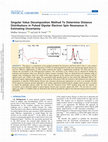
This paper is a continuation of the method introduced by Srivastava and Freed (2017) that is a ne... more This paper is a continuation of the method introduced by Srivastava and Freed (2017) that is a new method based on truncated singular value decomposition (TSVD) for obtaining physical results from experimental signals without any need for Tikhonov regularization or other similar methods that require a regularization parameter. We show here how to estimate the uncertainty in the SVD-generated solutions. The uncertainty in the solution may be obtained by finding the minimum and maximum values over which the solution remains converged. These are obtained from the optimum range of singular value contributions, where the width of this region depends on the solution point location (e.g., distance) and the signal-to-noise ratio (SNR) of the signal. The uncertainty levels typically found are very small with substantial SNR of the (denoised) signal, emphasizing the reliability of the method. With poorer SNR, the method is still satisfactory but with greater uncertainty, as expected. Pulsed dipolar electron spin resonance spectroscopy experiments are used as an example, but this TSVD approach is general and thus applicable to any similar experimental method wherein singular matrix inversion is needed to obtain the physically relevant result. We show that the Srivastava–Freed TSVD method along with the estimate of uncertainty can be effectively applied to pulsed dipolar electron spin resonance signals with SNR > 30, and even for a weak signal (e.g., SNR ≈ 3) reliable results are obtained by this method, provided the signal is first denoised using wavelet transforms (WavPDS).
Journal of Physical Chemistry Letters, 2017
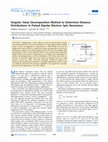
Regularization is often utilized to elicit the desired physical results from experimental data. T... more Regularization is often utilized to elicit the desired physical results from experimental data. The recent development of a denoising procedure yielding about 2 orders of magnitude in improvement in SNR obviates the need for regularization, which achieves a compromise between canceling effects of noise and obtaining an estimate of the desired physical results. We show how singular value decomposition (SVD) can be employed directly on the denoised data, using pulse dipolar electron spin resonance experiments as an example. Such experiments are useful in measuring distances and their distributions, P(r) between spin labels on proteins. In noise-free model cases exact results are obtained, but even a small amount of noise (e.g., SNR = 850 after denoising) corrupts the solution. We develop criteria that precisely determine an optimum approximate solution, which can readily be automated. This method is applicable to any signal that is currently processed with regularization of its SVD analysis.
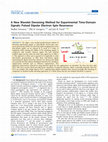
We adapt a new wavelet-transform-based method of denoising experimental signals to pulse-dipolar ... more We adapt a new wavelet-transform-based method of denoising experimental signals to pulse-dipolar electron-spin resonance spectroscopy (PDS). We show that signal averaging times of the time-domain signals can be reduced by as much as 2 orders of magnitude, while retaining the fidelity of the underlying signals, in comparison with noiseless reference signals. We have achieved excellent signal recovery when the initial noisy signal has an SNR ≳ 3. This approach is robust and is expected to be applicable to other time-domain spectroscopies. In PDS, these time-domain signals representing the dipolar interaction between two electron spin labels are converted into their distance distribution functions P(r), usually by regularization methods such as Tikhonov regularization. The significant improvements achieved by using denoised signals for this regularization are described. We show that they yield P(r)'s with more accurate detail and yield clearer separations of respective distances, which is especially important when the P(r)'s are complex. Also, longer distance P(r)'s, requiring longer dipolar evolution times, become accessible after denoising. In comparison to standard wavelet denoising approaches, it is clearly shown that the new method (WavPDS) is superior.
Signal Processing and Denoising by Madhur Srivastava
IEEE Access, 2021
We present a method to select decomposition levels for noise thresholding in wavelet denoising. I... more We present a method to select decomposition levels for noise thresholding in wavelet denoising. It is essential to determine the accurate decomposition levels to avoid inadequate noise reduction and/or signal distortion by noise thresholding. We introduce the concept of sparsity plot that captures the abrupt transition from noisy to noise-free Detail component, readily revealing the cutoff for the maximum decomposition levels. The method uses the sparsity parameter to determine the noise presence in each detail component and measures the magnitude change in the sparsity values to distinguish between noisy and noise-free Detail components. The method is tested on both model and experimental signals, and proves effective for various signal lengths and types, as well as different Signal-to-Noise Ratios (SNRs). The method can be embedded with any wavelet denoising method to improve its performance. The code is available via GitHub and denoising.cornell.edu, as well as the corresponding author's group website (signalsciencelab.com).
A new method is presented to denoise 1-D experimental signals using wavelet transforms. Although ... more A new method is presented to denoise 1-D experimental signals using wavelet transforms. Although the state-of-the-art wavelet denoising methods perform better than other denoising methods, they are not very effective for experimental signals. Unlike images and other signals, experimental signals in chemical and biophysical applications, for example, are less tolerant to signal distortion and under-denoising caused by the standard wavelet denoising methods. The new method: 1) provides a method to select the number of decomposition levels to denoise; 2) uses a new formula to calculate noise thresholds that does not require noise estimation; 3) uses separate noise thresholds for positive and negative wavelet coefficients; 4) applies denoising to the approximation component; and 5) allows the flexibility to adjust the noise thresholds. The new method is applied to continuous wave electron spin resonance spectra and it is found that it increases the signal-to-noise ratio (SNR) by more than 32 dB without distorting the signal, whereas standard denoising methods improve the SNR by less than 10 dB and with some distortion. In addition, its computation time is more than six times faster.
Image Processing by Madhur Srivastava
The paper presents a non-uniform quantization method for the Detail components in the JPEG2000 st... more The paper presents a non-uniform quantization method for the Detail components in the JPEG2000 standard. Incorporating the fact that the coefficients lying towards the ends of the histogram plot of each Detail component represent the structural information of an image, the quantization step sizes become smaller at they approach the ends of the histogram plot. The variable quantization step sizes are determined by the actual statistics of the wavelet coefficients. Mean and standard deviation are the two statistical parameters used iteratively to obtain the variable step sizes. Moreover, the mean of the coefficients lying within the step size is chosen as the quantized value, contrary to the deadzone uniform quantizer which selects the midpoint of the quantization step size as the quantized value. The experimental results of the deadzone uniform quantizer and the proposed non-uniform quantizer are objectively compared by using Mean-Squared Error (MSE) and Mean Structural Similarity Index Measure (MSSIM), to evaluate the quantization error and reconstructed image quality, respectively. Subjective analysis of the reconstructed images is also carried out. Through the objective and subjective assessments, it is shown that the non-uniform quantizer performs better than the deadzone uniform quantizer in the perceptual quality of the reconstructed image, especially at low bitrates. More importantly, unlike the deadzone uniform quantizer, the non-uniform quantizer accomplishes better visual quality with a few quantized values.

A Semi-automated Statistical Algorithm for Object Separation
"We explicate a semi-automated statistical algorithm for object identification and segregation in... more "We explicate a semi-automated statistical algorithm for object identification and segregation in both gray scale and color images. The algorithm makes optimal use of the observation that definite objects in an image are typically represented by pixel values having narrow Gaussian distributions about characteristic mean values. Furthermore, for visually distinct objects, the corresponding Gaussian distributions have negligible overlap with each other and hence the Mahalanobis distance between these distributions are large. These statistical facts enable one to sub-divide images into multiple thresholds of variable sizes, each segregating similar objects. The procedure incorporates the sensitivity of human eye to the gray pixel values into the variable threshold size, while mapping the Gaussian distributions into localized delta-functions, for object separation. The effectiveness of this recursive statistical algorithm is demonstrated using a wide variety of images.
""
Non-uniform Quantization of Detail Components in Wavelet Transformed Image for Lossy JPEG2000 Compression
Proceedings in 2nd International Conference on Pattern Recognition Applications and Methods, 2013., Feb 2013
The paper introduces the idea of non-uniform quantization in the detail components of wavelet tra... more The paper introduces the idea of non-uniform quantization in the detail components of wavelet transformed image. It argues that most of the coefficients of horizontal, vertical and diagonal components lie near to zeros and the coefficients representing large differences are few at the extreme ends of histogram. Therefore, this paper advocates need for variable step size quantization scheme which preserves the edge information at the edge of histogram and removes redundancy with the minimal number of quantized values. To support the idea, preliminary results are provided using a non-uniform quantization algorithm. We believe that successful implementation of non-uniform quantization in detail components in JPEG-2000 still image standard will improve image quality and compression efficiency with lesser number of quantized values.
Multisegmentation through wavelets: Comparing the efficacy of Daubechies vs Coiflets
Proceedings in SIGNAL PROCESSING and REAL TIME OPERATING SYSTEM, Mar 2011
In this paper, we carry out a comparative study of the efficacy of wavelets belonging to Daubechi... more In this paper, we carry out a comparative study of the efficacy of wavelets belonging to Daubechies and Coiflet family in achieving image segmentation through a fast statistical algorithm.The fact that wavelets belonging to Daubechies family optimally capture the polynomial trends and those of Coiflet family satisfy mini-max condition, makes this comparison interesting. In the context of the present algorithm, it is found that the performance of Coiflet wavelets is better, as compared to Daubechies wavelet.
Wavelet Based Robust Digital Watermarking Technique Using Reverse Additive Algorithm (RAA)
2009 Third UKSim European Symposium on Computer Modeling and Simulation, Nov 2009
"There are available several watermarking techniques used for data security. Digital media normal... more "There are available several watermarking techniques used for data security. Digital media normally assures fairly high quality, nevertheless can be easily reproduced in a perfect form. This perfect reproducibility takes an advantage from certain point of view, while it produces an essential disadvantage, since digital media is frequently copied illegally. A solution of this problem is to embed digital watermark that is not perceived clearly by usual people, but represent the proper right of original product. In this paper a Novel DWT based watermarking technique has been proposed and implemented using MATLAB .This technique shows better performance with respect to robustness and reliability than other existing technique."
Arxiv preprint arXiv: …, Jan 1, 2010
Through this paper a new algorithm is proposed for the segmentation of image into multiple segmen... more Through this paper a new algorithm is proposed for the segmentation of image into multiple segments using statistical parameters in wavelet domain. The procedure which is based on wavelet transform follows variable size segmentation with bigger block size around the mean, while smaller block size at the ends of histogram plot of each detail component. For approximation coefficients it is adapted finer block size around the mean, while larger blocks at the ends of histogram plot. In this algorithm, the block sizes are determined, adapting the statistics of histogram. In the process it highlights finer image structures which are not perceptible in the original image. It is worth emphasizing that after the segmentation only few wavelet coefficients captures the significant variation of images. This algorithm has been evaluated objectively and subjectively on the basis of Peak Signal to Noise Ratio (PSNR), Structural Similarity Measurement Index (MSSIM) and time complexity on various standard test images. Good improvements have been observed over other quantifiable method.
Magnetic Resonance Imaging (MRI) by Madhur Srivastava
Articulation Analysis Using Real Time Spiral MRI with TRACER
ISMRM 21st annual meeting, Apr 2013
In this study, the real-time spiral MRI combined with the TRACER reconstruction is used for artic... more In this study, the real-time spiral MRI combined with the TRACER reconstruction is used for articulation analysis. This method maintains coverage and spatial resolution but achieves a high temporal frame rate that is shown to be advantageous for the investigation of speech motor control.
Comparison of native and non-native consonant articulation with real-time magnetic resonance imaging of the vocal tract.
The Journal of the Acoustical Society of America, Jun 2013
This study examines the effects of vocalic context and stress on consonantal articulation using r... more This study examines the effects of vocalic context and stress on consonantal articulation using real-time magnetic resonance imaging (rtMRI) of the vocal tract. A native speaker of English and an L2 English speaker of Mandarin produced eight repetitions of a set of vowel-consonant-vowel sequences in which the target consonants-voiceless stops and nasals-occurred before or after a stressed vowel. Images of the mid-sagittal plane of the vocal tract were acquired with a sampling rate of 8.1 ms and were reconstructed using a variable density golden angle ordered spiral algorithm. Vocal tract variable time-series for each token were extracted from the images by taking the average pixel intensity for each frame in hand-labeled regions of interest. Analyses of variance were conducted on kinematic variables (movement range, velocity, and duration of consonantal closure and release movements) and relative timing of consonantal and vocalic gestural landmarks. The results showed greater effects of stress and vocalic context on articulatory kinematics and timing for the native speaker compared to the non-native speaker. This study demonstrates that rtMRI can be used to assess fine-grained differences in articulation that are likely attributable to language background.
Information Theory by Madhur Srivastava
Entropy Conserving Binarization Scheme for Video and Image Compression
Intellectual Property by Madhur Srivastava
Introduction of Intellectual Property Courses in STEM Curriculum
Proceedings in The 3rd IEEE Integrated STEM Education Conference (ISEC ’13), Mar 2013
The paper explains and emphasizes the need to include mandatory Intellectual Property (IP) course... more The paper explains and emphasizes the need to include mandatory Intellectual Property (IP) courses in the undergraduate and graduate curriculum of STEM students. It prescribes the proposed content of IP to be covered at undergraduate level, and graduate depending on the degree pursued by the STEM student. More importantly, this paper advocates for an Integrated PhD/JD degree to produce highly skilled patent attorneys and agents, to overcome the problem of poor quality of patents, and the high number of patent related litigations. A framework is suggested which would enable STEM departments and law schools to successfully offer this integrated degree, and students to successfully pursue and complete this degree program in a realistic manner; without compromising any stake holder's interest.



Uploads
Electron Spin Resonance (ESR) Spectroscopy by Madhur Srivastava
Signal Processing and Denoising by Madhur Srivastava
Image Processing by Madhur Srivastava
""
Magnetic Resonance Imaging (MRI) by Madhur Srivastava
Information Theory by Madhur Srivastava
Intellectual Property by Madhur Srivastava